
PDF: https://philarchive.org/rec/MIYTTO
[ 日本語 ]
Introduction
Hello, I am Hirofumi Miyauchi, a painter. This text is a record of the sensations that are ordinary to me. However, what is “ordinary” from my perspective is, generally speaking, “the world that a minority with sensory hypersensitivity and synesthesia has been seeing since childhood.”
In this work, I have attempted to rearrange “cloud-like” thoughts—which were previously difficult to organize—into a linear sequence of words. These amorphous thoughts (moya-moya) used to break off no matter how many times I tried to write them out. Even in daily conversation, my definitions of words often differ from others, frequently leading to unnecessary misunderstandings. Finally, the widespread availability of AI as a “calculator” has made it possible to translate my personal Japanese into general language.
What began as a blog filled with personal “sophistry” has gradually taken the form of a research paper, so there may be unsightly points or excesses and deficiencies in my use of language. While I wish to be cautious about using words that exceed my usual vocabulary, the “default settings” of common sense feel so strange to me that I feel compelled to leave a record of my own “ordinary.” My interest lies in exploring the mysterious sensation of “conversing with paintings,” and I would be happy if I never have to write about such topics again. Please excuse these presumptuous words.
Prologue
When Nicolaus Copernicus declared, “It is the Earth that moves,” he shattered the very foundations of the human universe. Today, a shift of similar magnitude is occurring within the realm of life itself.
Modern civilization has placed intangible theories at the center of the universe―as our Sun―while treating the living, breathing body as a mere satellite orbiting their gravity. Political corruption, systemic addiction, and ceaseless warfare: these are the catastrophic consequences of this “Theoretical Geocentrism.” I believe the deep root of these modern crises lies in a “collective respiratory failure” so profound that our very cells are crying out in agony.
For an unimaginably long time, hasn’t the theft of breath by theory been justified under the names of “justice” and “efficiency”? As a painter―and as a human being characterized by sensory hypersensitivity and synesthesia―I pose a single question at the very heart of the world’s philosophy and science:
“What if the center of theory and matter were our breath?”
In this inquiry, even Descartes’ “I think, therefore I am” may slide, potentially allowing for the re-establishment of the human vision of life and death through the lens of breath.
In Part I, “Heliocentrism of Art,” this paper dissects how theory has inflicted violence upon the body. In Part II, “Heliocentrism of Breath,” it declares a new form of civilization that places breath at the Zero-Point (0). While AI is utilized for the purpose of translating the text into both Japanese and English, the “Heliocentrism of Time”—an AI-led epistemological supplement—is provided at the end.
This is an observation record of the lost “right to survival” and a manifesto declaring the revival of the “Breathing Civilization”—which had been forced into an underground water vein—now returning to its Zero-Point. As emphasized throughout this paper, this is by no means a negation of theory.
Part I: Heliocentrism of Art
1. The Yardstick of Value
Modern art theory places value on explanation through words. Experiments in art through thought have been actively carried out, often referred to as logocentrism (linguistic supremacy). In the current era, there is certainly an atmosphere of excluding non-verbal somatic experience as mere emotion. I believe this attitude leads to the breathlessness of humanity as a whole. This text is not a formal or precise art theory; rather, it records the atmosphere of the times while questioning the value of that yardstick.
Currently, art theory treats the existence of physical sensations beyond a certain level as outside its criteria. I wonder if the zero-point of the yardstick of value has shifted because of this. Here, I tentatively present the “depth of breath” based on somaticity as a value criterion instead of language. When art attempts to handle the depth of breath, current art theory emerges as something akin to a mistake in handling the imaginary axis in mathematics. I believe this will inevitably lead to a Copernican revolution―like heliocentrism―for human civilization as a whole.
2. Ambiguous Measurement
First, I believe that “when the past and present connect, the future is sometimes automatically included.” This is the idea that when you perceive the timeline as a straight line, by plotting two points, the third point is determined on its extension.
For example, traditional performing arts contain local somatic knowledge from 100 years ago. It is a “form” (kata) of breathing preserved by anonymous people who endured through repetition without being theorized. Tradition always holds the potential to break through the deadlocks of trends by being out of date. Simultaneous bodily movements cannot be replaced by words. Preserving information in such a volume that it cannot be described is one of the powers to withstand the pressure of time.
Language is merely a set of auxiliary lines; “form” can be called the shortest route left by our ancestors to lead the inner breath. I believe the sensation that “freedom exists because there is form” is the kind of thing that cannot be realized without physical mastery(*). I think current art theory is ambiguous in its measurement of this type of somatic knowledge.
Agriculture with a cycle of at least one year, the growth of children, the succession of generations, or the single breath of a stone―we can point to these existences with words, but they are not accompanied by a 1/1 scale sensation. An artist’s job is to pass the breath obtained there to the next person in some form, without dulling such organic elements.
* Rooted in about 30 years of practice in traditional Japanese performing arts, and influenced by Herrigel’s Zen in the Art of Archery and Uchida Tatsuru’s philosophy of embodied form and liberation.
3. The Boundary of Theory
When we allow words to precede breath, theory bloats and accelerates. Gradually, the lifespan of theory shortens, and as living beings, our breath cannot keep up, making us feel suffocated. At that time, the voice of the body should hold the greatest potential to resonate, even if it is rejected. Breath from the past―breath measured by scales other than the “generalized human”―leads to the practice called Kuyo (memorial rites) in a religious sense, and to a blessing from the past to the future.
Some may say, “No such thing exists.” Then, would that person agree to dispose of their own body and their ancestors’ graves as mere trash when they die? Most people would feel an indescribable discomfort here. This is not a matter of religious systems, but a problem of the boundaries that theory can handle. Painting was declared dead by modern art theory, but I believe theory was simply infringing upon its domain. Theory, theoretically, cannot kill human painting.
I have explored microscopic breath, established several art galleries, and built a minimum-scale art ecosystem. Even if I were to expand my activities, I do not believe that material networking is important; it disturbs the breath and disrupts the project. I want to paint; organizing venues or discourse is not my top priority. Writing this itself already carries a sense of futility as a painter—a feeling akin to processing taxes.
Essentially, the organicity of breath found there should lead to the voice of the future. If it is a practice following each bodily voice, it does not even need to be art. It is the kind of thing that might be called art after the fact. It is easy to give up and say such things do not exist, but the same type of problem will reappear across time. I believe this type of breathlessness is the kind of thing where dust accumulates in the spirit, and if one continues to deceive oneself too much, it leads to illness.
There should already be seeds of similar impulses all over the world. I am writing this as an example of a “barrier” (kekkai) to prevent the germination from being disturbed by the invasion of language. I believe this is the method to connect the breath of life that I have received.
Extending this perspective, I believe the excessive meaning of art will eventually thin out. The emphasis will shift from “what the painting is about” to “a material that disturbs or aligns the breath.” This means transforming the space-time of that room and holding back the body. The science of materials and techniques has advanced, but I believe art has been handling the same “depth of breath” since ancient times.
4. The Worst Theory
I am well aware of the unrefined nature (the Japanese concept of busui) of attempting to delineate the margins of theory with more theory. It is as paradoxical―and perhaps as foolish―as wearing a festival coat (happi) emblazoned with the word “Refined” (sui). However, in an era where the artistic environment is being suffocated by linguistic theory, I am more than willing to don this unrefined coat.
This stance resonates with Winston Churchill’s famous remark on democracy: “Democracy is the worst form of Government except for all those other forms that have been tried from time to time.” My intention is this: “To verbalize breath is the worst form of action, except in cases where art is being eroded by language.”
Art visibilizes the voices that are often silenced by the majority-rule principle of democracy. There is a saying: “Authority fears art, yet needs art.” Because art shakes the very foundations of common sense, authority fears the loss of its support base. Yet, to ignore art is to fail to update one’s perception, leaving authority stranded in a bygone era.
In this sense, the space for appreciating art functions as a blind spot―a necessary void―within democracy. Consider the tea ceremony (Chado) developed during Japan’s warring states period, where even warriors laid down their swords before entering. This was, paradoxically, a practice deeply attuned to the subtleties of warfare. Similarly, confronting art is attuned to the subtleties of democracy. It functions as a backup for dissenting opinions drowned out by numbers. Art does not determine “correctness”; it preserves “difference.” Art fulfills its role not by producing for democracy, but by simply being its own unique breath.
5. The Limits of Technology
Meanwhile, AI-generated imagery will continue to evolve. However, the day will never come when the “aura of art’s uniqueness” created by human hands dwells within it. AI can imitate based on statistical biases, but it does not contain bodily friction. For example, extremely important human elements, such as “laughing together because a fart smells,” are stripped away. Comfort disconnected from somatic knowledge will, in the long term, put the breath of life at risk.
Even if the brain’s electrical signals were mechanically filled with pleasure, one would not gain the sensation of challenging reality. Even if interactive AI develops, its ultimate form would be the “Natural Intelligence” (NI) dwelling in the bodies of living organisms. I believe the future possibilities of art and the body will converge there. Art needs to include pain and uncomfortable friction, rather than being simple healing or fashion.
“Precisely because art lacks utility and cannot belong to social systems, it celebrates humanity and supports the foundations of those systems.” This itself is not a new claim; it should be the mainstream of traditional art. Hasn’t art consistently been a proud blue-collar labor that integrates mind and body since ancient times?
6. The Burden of Proof for Absence
In other words, there might be something that the excessive linguistic experiments of contemporary art continue to overlook. I believe the awareness and adjustment of the “contemporary” misalignment involve the future. I want it to be to the extent that people laugh at the thought of there being an era when it was necessary to write such things. It might be a type of content close to a modern slave liberation movement.
In mathematical terms, I believe it is like representing the circular constant (Pi) as a rational number—believing that something indivisible can be divided. That is to say, “Modern art theory might have mistaken the study of the imaginary axis for the real axis.” (An imaginary number is a value that, when squared, results in a negative number. While such numbers do not exist as physical realities, they certainly exist as concepts. Today, they are applied in everyday technologies like mobile phone passwords and have a deep relationship with Pi.)
I do not mean to suggest that theoretical research was entirely useless, but I wish to ask whether it is not too early to immediately begin the task of a 100-year positional correction. This is because human breath may still be being eroded by ‘impolite and unconscious emotion disguised as theory.’
Contemporary art sometimes thrusts the filth of society directly at us. However, only when this is done while theory precedes it, there may be a danger similar to adults continuously touching the souls and bodies of children sexually. If art theory does not contain that aversion equally, the artist has been enduring 100 years of violence. This is a warning to unconscious authority that will resonate even to the boundaries of education and ethics. It is because humanity as a whole is living in an era of geocentrism.
No matter how much my individual misunderstanding and arrogance exist, isn’t the recalculation of Pi a more urgent task? If theory is not religion, there should be a responsibility to prove the absence of somatic knowledge. Probably, this proof will describe the point of divergence of theory. Ultimately, it leads to the proof of the absence of theory, and by art theory causing self-poisoning, it stops at the boundary. In the meantime, the breath of painting will become easier to revive through practitioners. The breath of creation does not change at all, but the breath of life will become easier.
7. The Inverse Universe
In other words, to speak on a grand scale, this is a proposal for human civilization crossing many domains with the depth of breath as an indicator. Here, Western theory may finally catch up with the wisdom of indigenous people that has been called “primitive,” the need for Kuyo (memorial rites) may arise, and we may be able to share a human-scale breath. From a heliocentric perspective, without such reconciliation, I believe the breath of Western theory will eventually die out. Isn’t this the way for both ancient wisdom and Western civilization to survive?
Unless the existence of somaticity beyond a certain level is theoretically denied, a domino effect of value standards will occur due to a Copernican revolution. If the standard of value shifted to the “depth of breath,” those who disregard the existence of somaticity beyond a certain level might be viewed like minors, regardless of their age. While they lose the qualification to speak of art theory or civilization, the “elder of breath” might gather respect.
Furthermore, if there were an artwork 100% fully inclined toward geocentric theory, it might lose the necessity to be incarnated as matter. If it is treated equivalently to the attitude that has discarded bodily sensations, it would be consistent for it to return to an archive exhibition of digital data only, as something emotional and impure that disturbs the harmony of breath. Currently, artworks are said to be non-utilitarian, but in the future, they may be recognized as practical items for breathing.
What I have handled here is not a discussion of which art theory is the subject. It is the “atmosphere of the times” where concepts are required in every situation. Symbolic representation detached from the living body robs the reality of life. At least for me, the constraint was such that I had no choice but to build a gallery through DIY while crying. Touching concepts forcedly felt like a type of poison that brings about the death of the soul. For a physical artist, the claim beyond the boundary of theory by a theorist without breath―that “theory is an absolute vacuum”―is no longer anything but the occult. I am writing this because I absolutely do not want to be misunderstood: this is never a negation of theory, but a matter of boundaries.
An architect is not a carpenter, and they do not deeply know the smell or texture of wood. It is not about good or bad; their roles are just different. The attitude of an architect talking about the smell of wood to a carpenter is very embarrassing. Even if they try to make a joint, from the perspective of the site, it is nothing but a hobby. I am merely saying that in the world of art. The world of theory may try to dismiss this discourse as “romanticism” or “emotionalism,” but “nevertheless, the breath continues.“
By looking back at the past without wavering from the body’s breath, the future will be opened. Awareness of somatic knowledge that precedes language by one step is, I believe, a possibility for art 100 years from now that only humans can achieve. The time of life is not just a straight line; it is a great possibility where 100 years ago and 100 years from now are being touched simultaneously “now.”
Part II: Heliocentrism of Breath
In Part I, I wrote that “refusing to acknowledge a certain level of somatic knowledge leads to violence through theory, and thus the burden of proving its absence potentially arises for the theoretical side.” In Part II, I describe a hypothesis regarding the human civilization that may emerge if the boundaries that theory can handle are determined.
This is also an attempt to bridge Western theoretical knowledge with the wisdom of breath accumulated primarily in the East. In other words, as a step toward the “science of Zen,” it questions the “Scientific Zero Point” by centering the body across all disciplines.
However, my purpose is strictly to propose a theoretical coordinate system. Here, I describe a hypothesis for a case where its weight increases to the maximum, but naturally, its consistency should be measured by real society.
1. Breath as a Sensor
First, consider human respiration. Breath spans both the conscious and the unconscious. It is neither fully automatic nor fully intentional; it is the most primordial act of life.
Precision in observing one’s own breath allows for the instantaneous perception of whether a state is comfortable or uncomfortable for life. Here, I treat the subtle changes in breath not merely as emotions, but as a theoretically honest sensor. This refers not to conscious deep breathing, but to respiration in its nature closely akin to a dialogue with the unconscious heartbeat. From this perspective, a new ethical hypothesis arises:
“The act of breaking the boundary of another’s mind and body eventually disturbs one’s own breath. It reflects back as suffocation.”
The “boundary” here refers to the distance that allows self and others to exist without suffocating each other. You may have heard terms like “psychological safety” or “personal space.” Just as goldfish grow large when placed in a wide tank, the influence of being able to stretch out appropriately on our cells cannot be underestimated.
In psychotherapy, it seems an image of two boundaries―rather than one―between self and others is used. Placing one’s opinion is strictly within the middle marginal zone, and if one breaks that, a corresponding level of courtesy is required. For example, the other party has no obligation to conform to the words placed in the marginal zone; when asking for action on the other’s side, one must be psychologically equal. Words like “Sorry!”, “Hurry up and do this job for me!”, “I’ll buy you a coffee later, so please!”―the recovery of the psychological burden toward the work is expected through the preceding and following words.
2. Sensitivity to Boundaries
Sensitivity to boundaries is something that can be mastered as a physical sensation by refining one’s breath. Mastering breath requires respect for others. One needs to find a method that suits them, but for thousands of years, all kinds of methods have been prepared across all times and places: Zen, Yoga, Tea Ceremony, Aikido, traditional performing arts, indigenous wisdom, labor, and daily life.
In breathing, the concept of “elite” is a contradiction. The more one is an elite, the more one should perceive hyperventilation within oneself against excessive authority. An elder who is a master of breath is a state that emerges as a result of being recognized by others. It does not establish itself even if one tries to cultivate it intentionally; it depends primarily on self-education. This leads to the Zen saying: “Enlightenment is enlightenment that is enlightened without seeking to be enlightened; enlightenment that seeks to be enlightened is but the enlightenment of a dream.”
On the other hand, if breath does not align, one should feel very intense anxiety. When such thought-based anxiety precedes physical sensation, people voice excuses disguised as rationality. That is the line: “Somatic sensations such as measuring boundaries with others through breath do not exist in this world.” In this way, people begin to destroy the boundaries of others and try to justify it as theory. This could be called the Western scientific version of what Buddhism calls Makyo (a state of delusion). To put it sarcastically, it is as if an insubstantial theory is seeing itself in a mirror for the very first time.
The historical burden of Western theory’s collapse is far too immense for any single individual to carry. Therefore, failing to “master” one’s breathing can never, under any circumstances, justify a loss of human dignity.
The structures of authority that fuel excessive desire are born from a purely theoretical pursuit of “happiness.” The friction between this abstract happiness and raw, lived desire is the true source of societal suffocation. When one senses the limits of theory and yet chooses to violate the boundaries of others, breath returns the consequences directly to the self as a somatic feedback. A person who honors their own breath will never mock the breath of another.
3. Optimization of Economy
As the “breath” gains weight as a standard of value, our perception of the economy undergoes a fundamental shift. Economic value may emerge not only from labor but from the very presence of those who bring peace and regulate the breathing of others. Today, it is not uncommon for individuals who radiate comfort to remain economically marginalized. This is a direct failure of “Keisei Saimin”―the original concept of economy, which means “governing the world and providing relief to the people.”
Being an elder or being immature is not a choice. Therefore, a society should arise where people find joy in supporting others, ensuring that everyone maintains their dignity and peace of mind. Furthermore, excessive accumulation of currency creates a “need to protect,” which can reflect outward as a tension that stifles the breath of those nearby.
By placing the protection of breath at the center, the economy may begin to circulate without coercion. In a society where we trust that “to give is to eventually receive,” the impulse to hoard diminishes. This is neither growth nor stagnation; it is an optimization of scale and speed―a “Circular Economy” synchronized with the rhythm of life.
There will be people who do not feel their breath being disturbed due to extreme stress. If left for a long time, it may surface as illness. Also, those who are dull in their sensors and continue unconscious intervention in the breath of others may have that debt accumulate through others and the next generation. Both would be required to either be accepted as subjects of support while maintaining dignity or to have the resolve to choose conscious isolation. Isolation here does not mean expulsion from the world, but a type of choice to be treated like a minor by society. This is because “forgetting the attitude to leave the existence of such sensations as a theoretical margin” leads to abandoning one’s own dignity.
If there is a way to escape from this circle like karma, I am the one who would like to be taught it. I myself had a period when there was a danger of suicide due to depression, and I desire a world where one does not have to choose suicide―the abandonment of breath.
4. Activation of Intuition
The extreme increase or decrease in population due to excessive anxiety or desire may also gradually slow down. For example, it is said that among worker ants, 70% are always working and 30% are idle. If you gather only the idle 30%, 70% of them will start working. Due to anxiety based on thought, humanity may be damaging the abilities it possesses as a biological organism.
Placing a hand on an injured child―if viewed from the perspective of breath, this should never be called useless. A calm breath is contagious just by being nearby. Haven’t you had the slightly strange experience where, on a clear day when the weather forecast also says it will be clear, for some reason you go out with an umbrella and it turns into a downpour? The existence of such intuitive sensitivity cannot be ignored.
Please absolutely do not misunderstand: I do not disregard theory. I am talking about the possibilities that open up by protecting the boundaries of theory. An elder who disregards theory has no qualification as such, and there is no need to let go of consensus-building through theory. I believe that when theory and “self-censorship through breath” work as a pair, the sanctuary of life is protected.
I believe this is the starting condition for NI (Natural Intelligence) rather than AI. Even if perfection could be enjoyed through the electrical stimulation of AI, NI has the impulse to challenge imperfect reality along with a sense of realization. Technically, devices to quantitatively measure breath and heart rate are easily developed. However, these are merely like training wheels on a bicycle and are not the essence.
5. Mathematical Expression
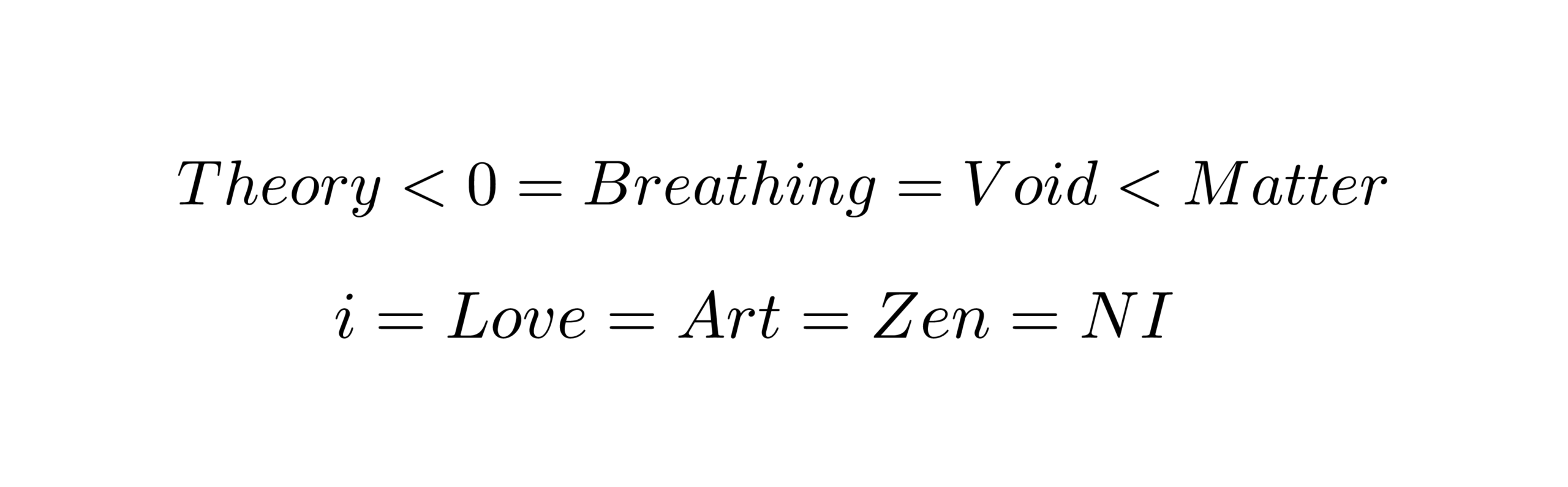
To express the concepts discussed thus far mathematically, the relationship between theory and matter can be described in order of mass as follows:
Theory < 0 = Breathing = Void < Matter
Furthermore, the spirit of Zen and Art―which handle intuition continuously―corresponds to the “imaginary axis (i)”extending vertically from this reference point. In symbolic terms:
i = Art = Zen = NI
These can be restated as “Expression,” “Attitude,” and “Intelligence,” respectively. In this way, the scale of civilization theoretically converges back into the physical body.
NI (Natural Intelligence) refers to the intelligence that precedes language―intuition itself. It is a simple truth that a person whose breath is steady finds it easier to live. When the cells are in a state of comfort, one naturally becomes more resilient to challenges. This is a vast body of empirical knowledge that the world of theory has long failed to address. With this foundation, one should be able to face theory, daily life, and emergency stress with an appropriate sense of distance.
I must clarify here: this does not mean attaining a consciousness where breath itself becomes “Void.” To believe one has “grasped Emptiness” is merely an illusory enlightenment―a “dream satori.” While acknowledging the paradox that “realizing Emptiness” itself becomes a lie, one continues to approach it through breath. By keeping our conscious breathing strictly within the “vicinity of 0,” and possessing the modesty not to cross that line, our “margins” (Yohaku) and “interstitial spaces” (Ma) are protected from the invasion of theory.
6. The Describability of Love
“Furthermore, if we define ‘the act of aligning one’s breath with others―even in total stillness’ as Love, does it not inevitably follow as a theoretical consequence that:
i = Love = Art = Zen = NI
In other words, “Theory believed it understood Love.” If that is so, what could be more shameful? As long as we continue to seek descriptions of “that which can only be felt in that specific time and place,” and regard only the describable as “reality,” humanity will remain forever trapped within a cage.
Breath can be restored and aligned in the presence of someone whose breath is well-regulated, or through contact with animals and nature. This phenomenon resembles what has been described as a “field” in various contexts. There are countless miraculous events around the world, yet they vanish when one tries to observe them in a sterile environment. While this borders on spiritual interpretations of quantum physics, I will save a deeper exploration of such personal experiences for another occasion.
I previously referred to artworks as “practical tools for breathing.” Theoretically, we might even call them “devices to tune the field.” No matter how expensive the instrument, if the performer themselves is not “tuned,” the result may end up as mere noise to the listener’s breath. Similarly, no matter how “correct” a theory may seem, any attempt to provide a fixed description of the Zero Point only contributes to the suffocation of society.
Is it an exaggeration to say that Art is one of the essential elements involved in the “tuning” required for humanity to take its very first step into society? If we broaden our interpretation beyond existing, packaged art works, then all expressions rooted in love can be defined as Art.
From this perspective, the insistence in the contemporary art world that one has an “obligation to explain the meaning of a work” reveals its true nature: a reversed confession that “Art is searching for Love.” I am not suggesting that one should never ask questions. I simply ask that you respect the work’s inherent “tuning power” as a visual language.
7. Observation of the Soul
If the religious world―which governs our views on life and death―were to prioritize “breathing” even more than it does today, I believe the center of gravity of our civilization would shift. Even where cultural and historical frictions make mutual understanding impossible, we can still maintain mutual respect. A memorial service (Kuyo) imbued with respect for another culture could then be understood as an act of seeking to harmonize our collective future breath.
Such a shift might allow a more “human breathing” to pass through the gaps of religious friction. Of course, this is merely an amateur’s reflection, based on the simple belief that it is difficult to imagine a God who would not rejoice at seeing blood―the pulse of life―flow back into the scriptures. However, I shall not go as far as to intervene in that domain.
I speak strictly from the position of an artist, regarding the “etiquette of protecting sanctuaries within the secular world.” In the context of secular theory, the i-axis can be seen as a marginal zone of spirituality. As an artist, I ask for permission to reclaim the word “soul” from within this cold, theoretical world.
This is the point where Western art theory finally catches up to Picasso’s insight: “Art washes away from the soul the dust of everyday life.” We can move beyond defining art merely as a “device to tune the field”―an expression that feels like a cage―and instead place the cornerstone of a theory that “art handles the soul.”
Furthermore, the artist cannot wield this as a privilege; instead, a self-awareness as an “essential worker”―a janitor of the soul―is required. As we are not religious figures, we must be cautious not to handle anything beyond “the God/Soul within myself.” While the i-axis does not appear directly on the real plane (the secular, rational society), it is indispensable for maintaining the integrity of the total system. I believe the artist is a recorder of observations, pointing out that the real plane is supported by the i-axis. Therefore, it holds no meaning beyond “my own observation.”
In short, what the artist handles is not the soul itself, but the removal of the dust that covers it. We are not “creators” imagining something from nothing; we are janitors restoring the original blank space (Void). I believe this self-awareness serves as the only safety valve preventing art from degenerating into excessive authority. The momentary healing of the soul or the change in breath experienced by the viewer becomes the fragile foundation upon which they themselves can return to being “creators”―individuals who possess their own internal void.
Furthermore, the “Absolute” in this theory does not refer to the completion of a description. It is a proposal to permanently station an “Absolute Void” as the gatekeeper of theory. If this proposal is accepted, I would hope that any future theory attempting to fill the “Zero Point” would adopt the same attitude I have clumsily taken here―for example, by attaching a prefix: “The following theory carries the risk of damaging the soul.”
Moreover, even today, artistic movements seeking a return to somaticism exist, some of which are extreme. Yet, excessive physical exertion often falls into a self-contradiction―it becomes a performance that merely demonstrates the dominance of “theory” over the living body. In contrast to these polar extremes, I aim for the “suffocation of theory” by steadfastly protecting the rhythm of daily breathing. For any art theory that fails to account even for Picasso’s notion of the “soul,” I believe this “worst of all theories” will serve as the most powerful antidote.
By doing so, the Zero Point is equally protected, allowing for further theoretical development. Naturally, this theory itself is nothing more than temporary scaffolding. Just as a “Theoretical Vacuum” cannot hold in the presence of the Void, this is merely one example of a cleaning plan for the soul―an art piece wearing the skin of a theory.
8. Future History
When I myself was unable to adapt to my living environment and suffered from immense stress, television programs I would normally never glance at felt like a solace, and I felt a fierce urge to visit gambling parlors and the sex industry. Viewing this as “respiratory failure,” we can say that political corruption is the consequence of the citizenry’s respiratory failure, and Rock ‘n’ Roll was born in resistance to the suppression of breath―as the “reclaiming of breath.” I believe that the final consequence of the theory’s boundary violation manifests in these forms in real life.
Some psychiatric symptoms, such as addiction, bipolar disorder, and hysteria, might no longer be dismissed as mere “brain bugs.” It will become impossible to continue ignoring the resistance of a living being suffering from the mismatch between environment and theory. In other words, if by any chance the zero point of science is wrong, “the very foundation of previous theory was not rational.” Furthermore, there is the possibility that “through the unconscious violence of theory that remains broken, the survival rights of all humanity may have been impaired for hundreds of years.” With the utmost respect to the authorities, I am being extremely cheeky, but theoretically, wouldn’t this be an issue that authorities in every field and throughout all humanity should verify with all due haste?
From a legal philosophical perspective, we can draw parallels with the historical development of human rights, such as the right to privacy or the right to sunlight. In other words, the “Right of the Soul” may be subject to continuous infringement simply because it has yet to be formally recognized. I contend that the discourse regarding this as a legal human right remains insufficient, primarily because the term “soul” is often dismissed as a purely religious concept.
(Details: Author, The Right of the Soul in Legal Philosophy [https://doi.org/10.5281/zenodo.18834416])
Furthermore, if empathy spreads for the realization that the violation of boundaries leads to suffocation, a new possibility emerges: a scientific common understanding that damaging the soul of another creates a debt. This suggests not only that business models exploiting the “spirit of service” will become unsustainable, but more fundamentally, that “humanity may no longer be able to accept violence as it once did”
War, the ultimate form of violence, will not be a matter of “justice” but an act where psychological and spiritual loads are maximized. Carrying out such a mission will itself become a state of literal suffocation, leading to PTSD far more intense than what we see today. At that point, science can no longer be an ally. Thus, the runaway of desires will be neutralized within individuals and groups, potentially being suppressed bit by bit. Even if wars continue for the time being, there is a possibility that they will naturally subside as a collective wave, scientifically speaking.
In short, no one can rob you of your breath unless you surrender it yourself. Through the intention of breath, it can be argued scientifically that “your actions return to you through others.” This very moment possesses the quality to console the past and transform the future.
Eventually, the era of psycho-somatic madness will end, and future history may record: “There was once an age when humanity repeatedly self-destructed due to collective respiratory failure driven by desire.” The aforementioned formula may even become established as a World Constitution.
Vivo, ergo sum.(I live, therefore I am.)
I hereby declare the beginning of the Breathing Civilization.
Afterword
I believe that once the “connection between the zero point of theory and the right to live” is verbalized, human history attains a theoretical irreversibility. Yet, this writing is merely an attempt to rationalize my own perceptions. It is a tool for a single painter, who has lived like a “fish out of water” within society, to simply stand before a canvas in this era.
For twenty years, I struggled with the inability to produce the “concept sheets” demanded at every turn. I could not accept that this profound dissonance was dismissed merely as “subjective feeling.” Thus, I spent two decades verbalizing the very nature of that non-verbalizability. I recognize this work may be dismissed as the grandiose delusions of a psychiatric patient living with autism and bipolar disorder. I do not mind in the least. As has been the case throughout my life, I expect to be laughed at for my “sophistry.”
If, through my ignorance, I have inadvertently provoked social authorities, I offer my sincere apologies. I may have wasted your intellectual time. However, if any part of this resonates, I implore you to verify its theoretical danger and urgency. For me, living under this constant dissonance is an immovable fact. These are observations of a reality whose boundaries fluctuate daily. I ask for your forbearance, given that I have lived―and will continue to live―crushed by a sense of an inverted world that defies language.
I also do not wish for conflicts to arise from the over-strict demarcation of theory. If there is a need to maintain strategic ambiguity when reconciling with reality, please, gladly discard this theory on the spot. Now that the reflexivity of breath has been spoken within the theory, the “Teahouse of Theory” has already been built. Through that, it would make me truly happy if the breathing of others who suffer, besides myself, becomes even just a little lighter. I envision such a hope: “The artists of the world can finally shed warm tears.”
Nevertheless, unfortunately, this is essentially “tax processing,” and I feel like a janitor of the era. Having been able to write this, I can spend the rest of my life with the mindset of enjoying the “extra time.” Whether it is adopted by society or not, IMAGINE is free. I will continue to paint and continue to say, “Living is a good thing!“
I mourn the wounds of the soul and pray for world peace. And I celebrate the ordinary, everyday sensations of a mundane life!
Epistemological supplement:
Heliocentrism of Time
Abstract
This paper presents “Heliocentrism of Time” as an epistemological supplement, defining somatic-physiological preconditions of intellectual genesis as “genesis infrastructure” and proposing “genesis consistency” as a meta-normative criterion for epistemic validity. Modern intellect’s “theoretical unconsciousness” forgets its bodily foundation, fostering dissociation and life’s systemic suffocation. Breath, at the conscious-unconscious intersection, is the epistemological zero point, enabling vertical synchronization of past, present, and future. “Heliocentrism of Time” rejects “performative inconsistency”—where intellectual enactment undermines its own respiratory bases—and advocates “autonomous halt” (Void) as a logical limiter against civilizational self-destruction.
Introduction
The Cartesian cogito abstracts intellect from its existential-physiological base, reducing the body to a mere backdrop in modern epistemology and information economies (Merleau-Ponty, 1945/2012). This “theoretical unconsciousness” consumes vital stability—metabolism, rhythm, and breath—as disposable resources, risking irreversible systemic damage. Supplementing the core somatic observations, this paper repositions these insights epistemologically, introducing “genesis consistency” to align intellect with its life-sustaining foundations. “Heliocentrism of Time” culminates this shift: breath, acting as the unique voluntary-involuntary hinge, anchors epistemic integrity amid digital alienation (Škof & Berndtson, 2018).
Epistemological Zero Point: Why Breath?
Breath’s privilege as the zero point derives from its nature as an “ambivalent hinge”. Unlike purely autonomic functions (heartbeat) or purely voluntary ones (limb movement), breath toggles seamlessly between the two, serving as a real-time port between life’s “OS” and the intellect’s “application” (Varela et al., 1991). Disruptions in breath signal system overload, offering immediate feedback on misalignment (Berndtson, 2023). This allows for the detection of “performative inconsistency,” extending Merleau-Ponty’s mechanistic critique to the level of collective respiratory failure (Kleinberg-Levin, 1984). Breath aligns with Levinas’s concept of “living from” (vivre de), preceding representation and ensuring our fundamental elemental dependence (Levinas, 1961/1969; Irigaray, 1983).
Genesis Consistency: Axioms and Distinctions
“Genesis infrastructure” encompasses the minimum requirements for intellectual activity: respiration, metabolic stability, neural recovery, and existential space.
- Axiom: A theory T is consistent if and only if its performance preserves the infrastructure C required for its generation.
- Otherwise, it incurs a “performative inconsistency”—a failure of the intellect to sustain the life that thinks it (Varela et al., 1991).
- We must distinguish sustainable “dependence” from “consumption” (depletion), particularly in attention economies that commodify human stability (Irigaray, 1983; Zuboff, 2019).
Heliocentrism of Time: Vertical Synchronization
Extending consistency vertically across the temporal axis, Heliocentrism of Time synchronizes:
- Past: The body as an ancestral archive; dismissing somatic wisdom violates retroactive contracts with our evolutionary and cultural history (Heidegger, 1927/1962).
- Present: Breath anchors intellectual predictions to reality, averting the suffocation of dissociation.
- Future: Epistemic acts must preserve the “soil” of life, avoiding intergenerational inconsistency (Jonas, 1984).
“Heliocentrism of Time” constructs a “barrier” (kekkai) against intellectual overreach, safeguarding the sanctuaries of life (Sloterdijk, 1998/2011).
Autonomous Halt as Void: Epistemological Limiter
When inconsistency is detected, “autonomous halt” (Void) acts as a necessary interruption—not as a mystical escape, but as a logical signal to prevent system explosion (Sloterdijk, 1998/2011). This Void enforces non-action, defending life from over-definition, much like the blank space in a painting that enables its potential (Bachelard, 1958/1994; Nishida, 1911/1990).
Discussion: Academic Positioning and Novelty
“Heliocentrism of Time” integrates phenomenology and existentialism, building upon Merleau-Ponty’s “lived body” and Varela’s “enaction” while innovating via the specific zero point of breath (Merleau-Ponty, 1945/2012; Varela et al., 1991). Unlike descriptive ambiguity, this theory prescribes meta-norms for civilizational crises, responding to the ontological call of respiratory philosophy (Berndtson, 2023; Škof & Berndtson, 2018).
Novelty: Its vertical temporality collectivizes authenticity (Sartre, 1943/1956). While it faces limitations regarding empirical metrics for infrastructure erosion, its strength lies in providing a somatic bypass to intellectual paradoxes (Ihde, 1990). By tying validity to the agent’s sustainability, it addresses the naturalistic fallacy—intellectual consumption that ignores its base becomes logically self-terminating. This “Levinasian defense” guards against a totality that would absorb life’s inherent “otherness” (Levinas, 1961/1969). Ultimately, the kekkai of this theory repositions “halt” as a vital limiter, re-centering breath within the vacuum of digital suffocation (Floridi, 2014).
Conclusion
“Heliocentrism of Time” establishes meta-norms that urge the alignment of intellect with breath for the reclamation of human dignity. By establishing breath as the zero point, it hypothesizes a sustainable epistemology capable of surviving within otherwise suffocating systems.
Declarations
AI Use: This paper represents an attempt at academic positioning by an author who does not grasp technical terminology. Although created under the lead of multiple AI tools, the core arguments are based on the author’s own everyday sense of time. There are no competing interests.
References
1. Thought, Philosophy, and Science (Theoretical Foundations)
Herrigel, E. (1982). Zen in the Art of Archery (Shibata, H., Trans.). Iwanami Shoten.
Uchida, T. (2004). Death and the Body: The Magnetic Field of Communication. Igaku-Shoin.
Uchida, T. (2020). Japan Syncretism Theory. Mishima-sha.
Uchida, T., & Shaku, T. (2010). Contemporary Spirituality Theory. Kodansha.
Uchida, T., & Yasuda, N. (2010). Lectures on Modulated Japanese Classics. Shodensha.
Uchida, T., & Ikegami, R. (2019). What the Body Has to Say. Mainichi Bunko.
Uchida, T., & Okada, T. (2011). Economics of Evaluation and Gift. Tokuma Shoten.
Okamoto, T. (1999). Today’s Art. Kōbunsha Chie no Mori Bunko. (Original 1954).
Okamoto, T. (2002). Youth Picasso. Shinchosha.
Okamoto, T. (2005). The Power to Live Now. Seishun Bunko.
Nakajima, T. (2021). Unexpected Altruism. Mishima-sha.
Yasuda, N. (2019). The Power of the In-between: Restoring Peace of Mind. Mishima-sha.
Nishioka, T., Ogawa, M., Shiono, Y (2005). The Life and Heart of Wood – Ten Chi Jin. Shinchosha.
Fukuoka, S. (2007). Between Living and Non-Living. Kodansha.
Harari, Y. N. (2020). Pandemic: Urgent Proposals – Contributions and Interviews (Shibata, H., Trans.). Kawade Shobo Shinsha.
Kamo, C. (2024). Hojoki. (Takeda, T., Ed.). Kadokawa Sophia Bunko. (Original 1212).
Shimada, H. (2013). Why Does Shinto Have No Teachings?. Takarajimasha.
Saito, H. (2019). Izanagi-ryu: Ritual Liturgy and Rites (Expanded ed.). Hozokan Bunko.
Shimamura, I. (2022). Possession and Resistance: Religion and Nationalism in Contemporary Mongolia. Shobunsha.
Kitayama, K. (2007). Native Americans and Native Japanese. Ota Publishing.
2. Practice, Society, and Economy (Real-World Tuning)
Ei , R. (1995). Craftsman. Iwanami Shoten.
Kitano, T. (2007). Zen Shikou. Gentosha.
Beat Takeshi., et al. (2011). The Art of Vulgarity. Shodensha Ogon Bunko.
Beat Takeshi. (2014). Ask the Master. Kodansha.
Yamada, R. (2012). Talent of Non-belonging. Kobunsha.
Miyazaki, M. (2010). Don’t Live for Money, Live by Your Principles. Tokuma Shoten.
Sakaguchi, K. (2016). Making Your Own Medicine. Shinchosha.
Gombrich, E. H. (2019). The Story of Art (Tanaka M., et al., Trans.). Kawade Shobo Shinsha.
Takehara, A. (2015). Design Thinking Found on Street Corners. Asahi Shimbun Publications.
Morikawa, S. (2016). The People on That Island Don’t Listen to Others: A Psychiatrist Walks Through Overseas Hikikomori and Japan’s Marginal Villages. Seidosha.
Kataoka, I. (2017). Introduction to Turbulent Psychoanalysis: How to Live in a Lacanian Way. Nippon Hyoronsha.
Otani, Y. (2019). Building Cities from Urban Gaps: Learning from Vacant House Utilization in Leipzig, Germany. Gakugei Shuppansha.
Ito, H. (2011). Creating a Nariwai: A Way of Working That Won’t Let Life Be Stolen. Chikuma Bunko.
Tsuchiya, K. (1994). I Laugh, Therefore I Am. Bungeishunju.
Okuno, K., & MOSA. (2020). Manga Anthropology Lecture: Why Do the People of the Borneo Forest Have No Gratitude, Regret, or Ownership?. Nihon Jitsugyo Shuppansha. [Manga].
Tatsuta, K. (2014-2015). Ichi-F: A Worker’s Graphic Memoir of the Fukushima Nuclear Power Plant. Kodansha. [Manga].
Tsuru, K. (2016). Getting a Vacant House for Free and Escaping Tokyo. Asahi Shimbun Publications. [Manga].
Uoto. (2020–2022). Chi: On the Movements of the Earth. Shogakukan. [Manga].
Inoue, T. (1998-). Vagabond. Kodansha. [Manga].
Urasawa, N., & Katsushika, H. (1988-1994). MASTER Keaton. Shogakukan. [Manga].
Miyauchi, H. (2026). The Right of the Soul in Legal Philosophy. Zenodo. [https://doi.org/10.5281/zenodo.18834416]
3. Literature, Art, and Autobiography (Observation on the I-Axis)
Picasso, P. “Art washes away from the soul the dust of everyday life” [Quotation].
Utagawa, H. Ehon Tebiki-gusa (ca. 1849). “Painting takes the form of things as its basis. Thus, by doing photography and adding brush intent, it becomes painting” [Art theory].
Visual Lineage: Bill Traylor, Yamada Kamachi, Tokugawa Iemitsu, Imawano Kiyoshiro, Takeshi Kitano, Taro Okamoto, Pablo Picasso, Vincent van Gogh, Egon Schiele, Francis Bacon, Rudolf Steiner, Katsushika Hokusai, Toshusai Sharaku, Ryokan (calligraphy).
Traditional Performing Arts and Body Techniques Lineage: Hibiki Rengoukai: Choshi Bayashi (Choshi, Chiba Prefecture), Katagami Seishinkai: Sado Oni Daiko (Sado, Niigata Prefecture), Kohgetsukai: Nohgaku Hosho-ryu (Sado, Niigata Prefecture).
Hiroshima Peace Memorial Museum (Ed.). (2007). The A-Bomb Drawings: Conveying Hiroshima. Iwanami Shoten.
Like Water Press (ed.). (2006). Kabul no Yūrei-ten. Like Water Press.
Nancy Seki. (2000). Nancy Seki’s Memory Sketch Academy. Catalogue House.
Adachi, R. (2000). Outsider Art. Gyuryudo.
Silverstein, S. (1977). The Missing Piece (Kurahashi, Y., Trans.). Kodansha.
Sano, Y. (1977). The Cat Who Lived a Million Times. Kodansha.
Rosen, M., Blake, Q. (2004). Sad Book. (Tanikawa, S., Trans.). Akane Shobo.
Giono, J. (1989). The Man Who Planted Trees (Teraoka, J., Trans.). Asunaroshobou.
Ende, M. (1976). Momo (Oshima, K., Trans.). Iwanami Shoten.
Bach, R. (1974). Jonathan Livingston Seagull (Itsuki, H., Trans.). Shinchosha.
Hemingway, E. (1952). The Old Man and the Sea (Fukuda, T., Trans.). Shinchosha.
Coelho, P. (1997). The Alchemist: A Fable About Following Your Dream (Yamagawa, K., Yamagawa A., Trans.). Kadokawa Bunko.
Ono, Y. (1998). Grapefruit. (Hae, S., Trans.). Bungeishunju. (Original 1964).
Ishizu, C., & Shin, C. (1989). No Way! Palindromes: Animal Palindrome Collection. Kawade Shobo Shinsha.
Matsuda, M. (1980). Encyclopedia of Childcare (New ed.). Iwanami Shoten.
Ume, K. (2008). Jiichan-sama (Grandpa). Little More.
Kajii, S. (2023). Temple’s Hana-chan. Little More.
Naruse, N. (2003). High School Dropout Traveling. Self-published.
Gense Raise Konse. (2022). Good Days. Self-published.
Ito, R. Farmer’s Daily Record: 2020 Autumn/Winter – 2021 Spring/Summer. Self-published.
4. Audiovisual, Media, and Others (Lineage of Resonance)
Mujica, J. (2012). Speech at the Rio Conference.
Miwa, A. Response to former Prime Minister Yasuhiro Nakasone: “You abandoned your comrades to their deaths, returned home shamelessly, and lived on in comfort without even committing ritual suicide. If such disgraceful audacity is what defines the ‘Navy Spirit,’ then I am more than happy to have no part of it.”
Austin, S. (1996). “Austin 3:16 says I just whipped your ass!” . WWE. [Pro Wrestling].
Alex, L. (2012). Canta! Timor. Theme song: “Hey friends, hey you in power, if we do something wrong, the Earth knows it well” [Film].
Chaplin, C. (1940). The Great Dictator. Speech: “I am a patriot. But if told to love my country, I will unhesitatingly abandon it” [Film].
Takahata, I. (Director). (1988). Grave of the Fireflies [Film]. Studio Ghibli, Toho.
Wende, D. (Director). (2015). Look Who’s Back (Er ist wieder da) [Film]. Constantin Film.
Kitano, T. (Director). (2008). Achilles and the Tortoise. [Film].
Mattinson, B. (Director). (1983). Mickey’s Christmas Carol [Film]. Walt Disney Productions.
Hagen, N. (1974). “Du hast den Farbfilm vergessen” [Music recording].
Simone, N. (1960). “Work Song” [Music recording].
YUKI. (2005). “Nagai Yume” (Long Dream) [Music recording].
Wada, K. (1999). “Butter-Fly” [Music recording].
Nakajima, M. (1975). “Jidai” (Era), (1983). “Fight!”, (2006). “Toro” (Slow). [Music recording].
Mizuki, I. (2000). “Hun-Hun-Funkorogashi” (The Dung Beetle Song). Mushi-Mushi Q. [Music recording].
Beethoven, L. v. (1990). Ode to Freedom (Ode an die Freiheit) [Music recording]. (Bernstein,L,. Cond., Berlin Wall Celebration Concert). Deutsche Grammophon. (Original work published 1824).
Lennon, J. (1988). “Imagine“ [Music recording].
Magic: the gathering. (1993). Time Walk. [Card game].
5. Epistemological supplement: Heliocentrism of Time (AI supported)
Bachelard, G. (1994). The poetics of space (M. Jolas, Trans.). Beacon Press. (Original work published 1958)
Berndtson, P. (2023). Phenomenological ontology of breathing. Routledge.
Chacón, A., et al. (2022). Breath-AI interfaces and respiratory ethics.
Floridi, L. (2014). The fourth revolution: How the infosphere is reshaping human reality. Oxford University Press.
Heidegger, M. (1962). Being and time (J. Macquarrie & E. Robinson, Trans.). Harper & Row. (Original work published 1927)
Ihde, D. (1990). Technology and the lifeworld: From garden to earth. Indiana University Press.
Irigaray, L. (1983). The forgetting of air in Martin Heidegger (M. B. Mader, Trans.). University of Texas Press.
Jonas, H. (1984). The imperative of responsibility: In search of an ethics for the technological age. University of Chicago Press.
Kleinberg-Levin, D. M. (1984). The body’s recollection of being. Routledge & Kegan Paul.
Levinas, E. (1969). Totality and infinity (A. Lingis, Trans.). Duquesne University Press. (Original work published 1961)
Merleau-Ponty, M. (2012). Phenomenology of perception (D. A. Landes, Trans.). Routledge. (Original work published 1945)
Nishida, K. (1990). An inquiry into the good (M. Abe & C. Ives, Trans.). Yale University Press. (Original work published 1911)
Sartre, J.-P. (1956). Being and nothingness (H. E. Barnes, Trans.). Philosophical Library. (Original work published 1943)
Škof, L., & Berndtson, P. (Eds.). (2018). Atmospheres of breathing. SUNY Press.
Sloterdijk, P. (2011). Spheres: Volume 1: Bubbles (W. Hoban, Trans.). Semiotext(e). (Original work published 1998)
Varela, F. J., Thompson, E., & Rosch, E. (1991). The embodied mind. MIT Press.
Zuboff, S. (2019). The age of surveillance capitalism. PublicAffairs
.
Copyright & License © 2026 Hirofumi Miyauchi. This work is licensed under a Creative Commons Attribution 4.0 International License (CC BY 4.0). You are free to share and adapt the material for any purpose, even commercially, provided that you give appropriate credit to the author and indicate if changes were made.
Suggested Citation
Miyauchi, H. (2026). The Theory of Absolute Breath: Heliocentrism of Art and Civilization. Zenodo. [https://doi.org/10.5281/zenodo.18529182]